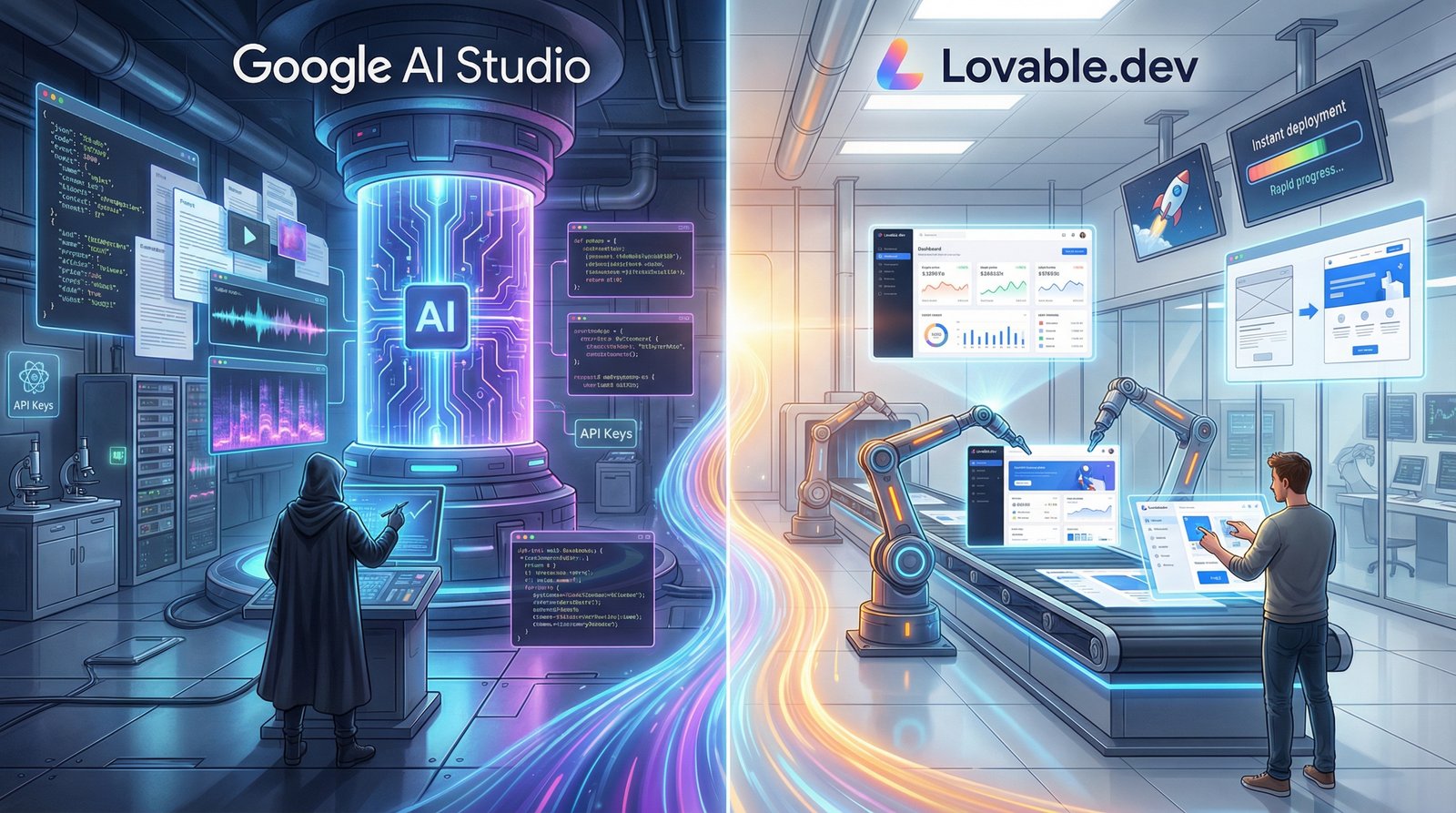
Google AI Studio vs. Lovable.dev: Choosing Your AI App Builder
Selecting the right AI-powered app development tool is crucial for accelerating projects from concept to launch. Google AI Studio and Lovable.dev offer distinct pathways to building applications with AI, catering to different user needs and project scopes.
Google AI Studio provides a free, powerful "sandbox" with direct access to Google's latest models, while Lovable.dev is a polished, paid "product builder" specialized for rapidly shipping full-stack applications.
Build Mode: A Game Changer
Google AI Studio's recent "Build Mode" update significantly elevates its capabilities, positioning it as a direct competitor to specialized tools like Lovable.dev. This new feature now provides similar "text-to-app" functionalities, and importantly, it's available for free.
Core Differences at a Glance
Deciding between Google AI Studio and Lovable.dev largely hinges on your specific requirements:
- Best For: Google AI Studio suits developers and experimenters seeking free, unrestricted "vibe coding." Lovable.dev targets founders, non-coders, and startups focused on building production-ready SaaS or MVPs.
- Cost: Google AI Studio is currently free with generous limits for its Build Mode. Lovable.dev is a paid service, starting around $20/month plus credit limits.
- Primary Models: Google AI Studio leverages Gemini 2.0 / 1.5 Pro, offering Google's cutting-edge AI. Lovable.dev employs a multi-model approach, utilizing Claude 3.5 Sonnet and GPT-4o for code generation.
- Backend Integration: Google AI Studio integrates seamlessly with Firebase and Google Cloud. Lovable.dev offers native integration with Supabase.
- User Experience: Google AI Studio provides a "Developer Playground" feel—fast, raw, and experimental. Lovable.dev delivers an "App Builder" experience—polished, guided, and distinctly project-focused.
Deep Dive: Google AI Studio (Build Mode)
Often perceived as a "sleeping giant," Google AI Studio's Build Mode now brings substantial power to the forefront.
Pros:
- Completely Free: Iterating ideas is cost-free, with no credit system or paywall currently in place for Build Mode. This enables limitless experimentation.
- Massive Context Window: Powered by Gemini, it boasts a 1M+ token context window. This allows it to comprehend and remember extensive project code and documentation as your application evolves, minimizing confusion.
- Google Ecosystem Integration: Enjoy direct access to Google Search, Maps, and YouTube data without the complexities of configuring multiple API keys.
- Multimodal Input: The ability to provide video or screen recordings and instruct the AI to "Build this" demonstrates exceptional understanding and responsiveness to visual cues.
Cons:
- "Sandbox" Feel: It leans more towards a prototyping tool than a permanent home for a business. While production deployment (e.g., via Cloud Run/Firebase) is feasible, it may lack the one-click simplicity found in dedicated app builders.
- Tech Stack Bias: Strongly favors Google's proprietary tech stack. Users preferring PostgreSQL (Supabase) or AWS might find it less accommodating for their existing infrastructure or preferences.
Deep Dive: Lovable.dev
Lovable.dev positions itself as a premium "GPT Engineer" for founders, meticulously designed to streamline the journey from idea to a shipped product with minimal friction.
Pros:
- Production Focus: Builds robust full-stack applications using industry-standard technologies such as React, Tailwind, and Supabase. These applications are easily exportable and hostable on any platform.
- Database & Auth Automation: Offers best-in-class Supabase integration, automatically configuring authentication (login/signup) and database tables. This feature significantly simplifies what is often the most challenging part for non-coders.
- GitHub Sync: Provides seamless two-way synchronization with GitHub, enabling developers to manually refine code in VS Code while the AI concurrently continues building and updating the project in the browser.
- Polish & UI: The user interface is purpose-built for product development, featuring tools for version management, custom domain deployment, and iterative design improvements.
Cons:
- Cost-Sensitive: Operates on a credit system. Generating complex applications can quickly deplete monthly credits, potentially necessitating plan upgrades or waiting periods.
- Credit Anxiety: The credit model might discourage experimentation with riskier or unproven ideas due to the concern of wasting valuable credits—a fear that Google AI Studio's free model largely eliminates.
Which One Should You Choose?
Your optimal choice hinges on your specific project goals, technical proficiency, and available resources.
Choose Google AI Studio if:
- You are learning, experimenting, or require a powerful development tool without recurring monthly fees.
- You are a developer aiming to quickly prototype a UI or app concept and then plan to further develop or deploy the code elsewhere.
- Your application will heavily utilize or integrate with Google services, such as Google Maps.
- Your project involves an exceptionally large context (numerous files, extensive documentation) that benefits from Gemini's massive context window.
Choose Lovable.dev if:
- You are a founder determined to launch a startup or MVP rapidly, perhaps within a weekend.
- You need an automated backend setup (Database + Authentication) instantly, without the complexities of configuring Firebase or similar services.
- You prefer a guided, highly polished development experience that feels more like a software factory than a raw code editor.
- You are prepared to invest approximately $20-50/month to significantly save on setup and development time.
My Recommendation
Start your development journey with Google AI Studio. Its free access allows you to thoroughly refine your idea and optimize your prompt structures without any financial commitment. If you subsequently encounter challenges with deployment or database complexities as your project scales, then transition your refined concept to Lovable.dev to build the final, production-ready version with its specialized features.