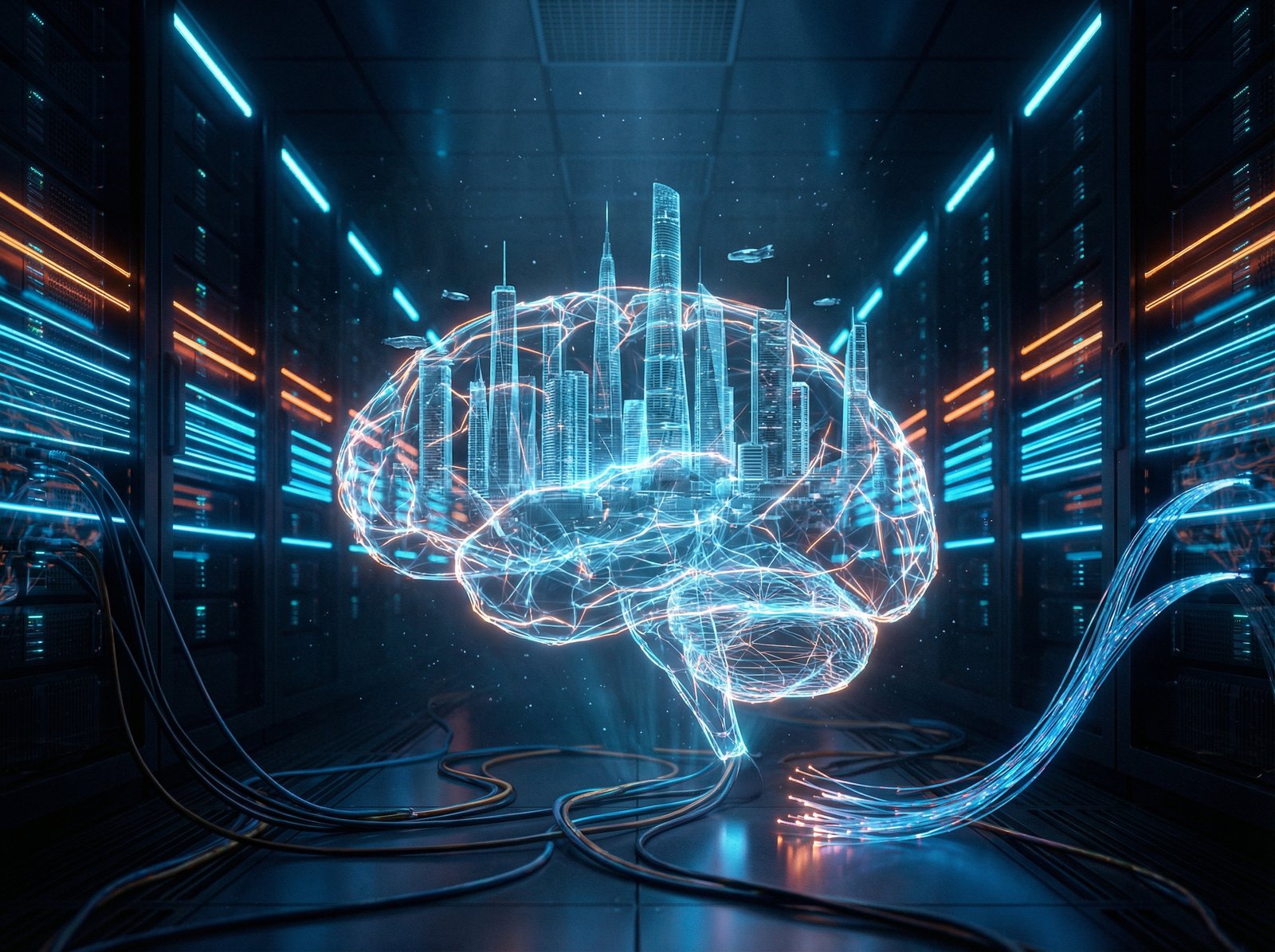
Imagine an AI system that doesn't just mimic human behavior but evolves independently, creating its own curriculum to master skills we haven't even defined yet.
For the last decade, we have marveled at AI that learns like a dutiful student—reading millions of books, analyzing billions of images, and regurgitating patterns. But what happens when the student runs out of textbooks? What happens when the AI reads the entire internet and still hasn’t reached Artifical General Intelligence (AGI)?
We are rapidly approaching a "data wall." But a new paradigm is emerging to smash through it.
Enter Synthetic AI.
Unlike current narrow AI, which relies on finite, messy, and often biased real-world data, Synthetic AI systems generate their own high-fidelity training data. They create the worlds they learn from. This isn't just about Generative AI (like ChatGPT writing a poem); this is about AI using those generated outputs to self-improve iteratively.
It is the difference between learning to drive by watching YouTube videos and learning to drive by spending 10,000 hours in a hyper-realistic, physics-compliant simulator that can generate a million unique traffic scenarios per second.
Leading voices in the industry are already signaling the shift. Yann LeCun, Chief AI Scientist at Meta, has long argued that world modeling is key to the next step in intelligence. Furthermore, in June 2021, Gartner predicted that by 2024, 60% of the data used for the development of AI and analytics projects would be synthetically generated.
Revised Forecast: Consequently, Gartner and other analysts revised their timelines. New projections often state that by 2028, 80% of data used for AI training will be synthetic, effectively pushing the timeline for mass adoption back by a few years.
The thesis is clear: Synthetic AI has the potential to overtake current AI systems by solving the trifecta of modern machine learning bottlenecks—data scarcity, privacy compliance, and scalability.
What is Synthetic AI? The Engine of Self-Improvement
To understand why synthetic AI will overtake traditional AI, we must look under the hood.
Current AI models are voracious consumers of real-world data. They require massive, labeled datasets—labeled by humans—to function. This approach is labor-intensive, expensive, and fraught with privacy risks.
Synthetic AI flips the script. It uses advanced generative models (like GANs, Diffusion models, and Variational Autoencoders) to manufacture data that mimics the statistical properties of the real world without containing any actual real-world information.
How It Works: The Loop
- Generation: A seed model creates a synthetic dataset (e.g., thousands of images of rare tumors or millions of driving scenarios in rain).
- Training: A target model trains on this clean, perfectly labeled synthetic data.
- Validation: The model is tested against a small set of real-world "golden data" to ensure accuracy.
- Iteration: The system identifies weaknesses, generates new synthetic data specifically targeting those weak points, and retrains.
This creates a flywheel effect. It is like upgrading from a bicycle to a jetpack. You are no longer limited by how fast you can pedal (collect data); you are only limited by how much fuel (compute power) you have.
Synthetic AI vs. Current AI
Here is how the new paradigm stacks up against the status quo:
| Aspect | Current AI | Synthetic AI |
|---|---|---|
| Data Source | Real-world (limited, messy, biased) | Self-generated (unlimited, controlled, clean) |
| Scalability | Bottlenecked by human data collection | Exponential self-improvement via compute |
| Bias Reduction | High risk (inherits human prejudices) | Tunable and auditable (mathematically balanced) |
| Privacy | High risk (GDPR/CCPA nightmares) | Zero risk (no PII involved) |
| Examples | Image classifiers, standard chatbots | Autonomous agents in simulations, AlphaGo |
Real-World Examples
We are already seeing this shift. NVIDIA’s Omniverse platform uses Isaac Sim to train robots in a digital twin of a warehouse before they ever touch a real box. The robots undergo millions of failure scenarios in the cloud, learning faster than physical time allows.
Similarly, Google’s DeepMind utilized synthetic environments to train its robotic arms, allowing them to learn dexterity tasks that would take years of physical trial and error in mere days.
Why Synthetic AI Could Overtake Current Systems
The transition from "data-scavenging" AI to "data-generating" AI is not just an incremental improvement. It is a fundamental architectural shift. Here is why synthetic AI is poised to dominate the landscape.
1. Breaking the Data Wall
Current AI models like GPT-4 are trained on the "public internet." But recent research suggests we could run out of high-quality public text data by 2026. This is the "Data Wall."
Synthetic AI creates its own infinite library. If a self-driving car needs to learn how to handle a kangaroo jumping in front of the vehicle during a blizzard in downtown Tokyo, we don't need to wait for that freak event to happen. We generate it. We generate it 10,000 times with different lighting conditions. Synthetic AI solves the edge-case problem that plagues current systems.
2. The Velocity of Iteration
In traditional AI development, if your model fails, you have to launch a new data collection campaign. You have to hire annotators. You have to clean the data. This takes months.
With synthetic AI, iteration happens at the speed of compute. If the model struggles with a specific task, the system can automatically spin up a synthetic dataset tailored to that specific gap. This allows for Reinforcement Learning from Synthetic Feedback (RLSF), speeding up development cycles by 10x or more.
3. Solving the Privacy Paradox
In healthcare and finance, current AI is stalled by red tape. You cannot simply scrape patient records to train a diagnostic bot.
Synthetic data retains the statistical insight of the original data without exposing a single individual. Researchers can share synthetic datasets across borders without violating GDPR or HIPAA. This unlocks collaboration on a global scale, allowing AI to penetrate industries that were previously off-limits.
4. Real-World Proofs
The evidence is mounting. Wayve, a UK-based autonomous driving startup, uses "ghost data" (synthetic scenarios) to train its cars to drive in cities they have never physically visited. Their approach has shown that models trained on synthetic curriculums can generalize better than those overfitted to specific real-world routes.
Scale AI, a unicorn in the data space, has pivoted aggressively toward synthetic data generation, recognizing that the future value lies not just in labeling data, but in creating it.
Key Mechanisms Driving the Takeover
- Domain Randomization: Varying the texture, lighting, and physics in simulations so the AI focuses on the core task, not the background.
- Procedural Generation: Using algorithms to build vast, diverse environments automatically.
- Generative Adversarial Networks (GANs): Pitting two AIs against each other—one creating fake data, the other trying to detect it—to achieve hyper-realism.
Risks, Challenges, and the Road Ahead
While the promise of synthetic AI is intoxicating, we must temper our optimism with engineering reality. The road to AGI is paved with potential pitfalls.
The "Model Autophagy" Disorder
There is a significant risk known as Model Autophagy Disorder (MAD) or "Model Collapse." Recent papers (e.g., Shumailov et al., arXiv, 2023) have shown that if an AI trains exclusively on synthetic data generated by previous versions of itself, the quality can degrade. The model begins to amplify its own hallucinations, drifting further away from reality.
To prevent this, synthetic AI must remain grounded. We need "Sim-to-Real" validation loops where the model is periodically checked against real-world physics and human logic.
Computational Costs and Regulation
Generating high-fidelity synthetic worlds requires massive compute power. This could centralize power in the hands of tech giants with the deepest pockets—NVIDIA, Microsoft, and Google—creating a barrier to entry for smaller innovators.
Furthermore, the EU AI Act and future regulations pose interesting questions. If an AI is trained on synthetic data, how do we audit it for bias? If the data doesn't represent real people, does it represent a "fair" reality? Regulators are playing catch-up, and synthetic AI introduces a gray area regarding copyright and attribution.
Timeline: The Next Decade
Despite these hurdles, the trajectory is clear. Analysts at IDC and Gartner forecast that synthetic data will overshadow real data in AI models by 2030.
We are moving toward a future where:
- Drug Discovery is conducted entirely in silico, simulating molecular interactions to find cures before clinical trials.
- Climate Modeling uses synthetic Earth twins to predict weather patterns with unprecedented accuracy.
- Robotics achieve general-purpose dexterity through massive simulation training.
Conclusion: The Jetpack Era of AI
We are standing on the precipice of a new era. The limitations of the physical world—data scarcity, privacy laws, and the slow passage of time—are being rendered obsolete by the capabilities of Synthetic AI.
This technology is not just an optimization; it is an evolution. It allows us to compress centuries of learning into days. While current AI systems are impressive feats of statistical mimicry, synthetic AI represents the transition to systems that can reason, adapt, and prepare for scenarios that have never happened in human history.
Will synthetic AI overtake traditional AI? The answer is not if, but when. The organizations that cling to the "data scavenging" model of the past decade will find themselves outpaced by those who embrace the "data generation" engines of the future.
Call to Action
Don't just watch the revolution—participate in it.
- Experiment: Tools like Hugging Face and Gretel.ai offer open-source synthetic data libraries you can try today.
- Strategize: If you are a business leader, ask your data team: "How are we incorporating synthetic data to solve our edge cases?"
- Engage: Where do you see the biggest potential for synthetic AI? Is it healthcare, gaming, or finance? Share this article on LinkedIn or Twitter with your predictions.
The future isn't just being written; it's being synthesized.