Beyond Replacement: What AI Truly Reveals About Human Creativity
For years, the conversation around artificial intelligence and creativity has been dominated by a single, powerful narrative: replacement. We’ve seen AI as a tool for efficiency, a tireless assistant capable of generating images, writing copy, or composing music faster than any human. While this view holds some truth, it ultimately misses the far more interesting story. AI isn't just changing what we create; it's fundamentally reshaping how we create and forcing us to ask profound questions about what makes human ingenuity so special in the first place.
Beyond the endless hype and anxiety, a more nuanced reality is emerging. Artists, musicians, and writers are discovering that AI's most powerful function isn't mere automation, but rather a catalyst for collaboration, disruption, and deep reflection. Here are four surprising truths about creativity in the age of AI.
1. The Paradox of Perfection: When 'Good' Isn't Good for You
We often assume that any tool making things easier is inherently good. AI-powered platforms can produce polished images and error-free text with a single click, saving us from the frustration of a clumsy first draft. But what if that very frustration is the whole point?
Researchers are beginning to worry that by removing struggle, AI might inadvertently stunt our creative growth. The messy process of trial and error—of failing, learning, and trying again—is essential for developing deep skills and true mastery. When an AI tool prevents you from making mistakes, it also prevents you from learning from them. As computational creativity researcher Mike Cook warns:
“Unfortunately, we’re removing the one thing that you have to do to develop creative skills for yourself, which is fail. But absolutely nobody wants to hear that.”
Why it matters: True mastery isn't about getting a perfect result on the first try. It’s about the resilience and wisdom gained through the struggle. Over-reliance on tools that smooth over every bump could rob the next generation of creatives of the very process that fosters genuine expertise.
2. The New Workflow: Destroy, Rework, Humanize
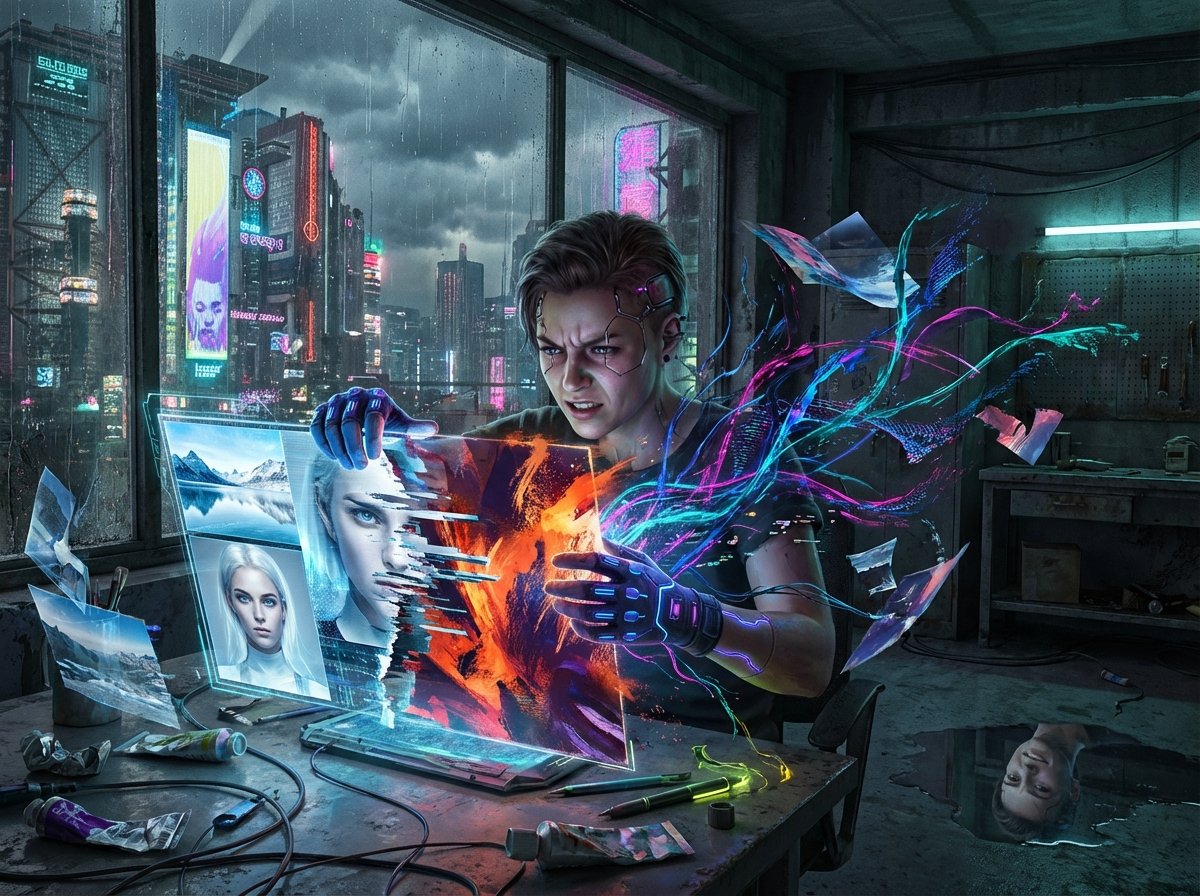
Instead of being replaced, many artists are finding their roles evolving from sole creators to creative directors. In this new workflow, the artist's job isn't to start with a blank canvas, but to guide, curate, and wrestle with the output of an AI.
The goal is not to passively accept the machine's first draft, but to use it as a starting point for something uniquely human. This involves a process of strategic deconstruction and intuitive rebuilding, layering the AI's computational precision with human emotion, cultural context, and lived experience. As one multimedia artist explains, the process is a dynamic partnership:
“I use AI to generate the starting point, and then my job is to destroy it, rework it, humanize it.”
Why it matters: This reframes the artist's value proposition. In a world saturated with AI-generated content, the most valuable skills are no longer just technical execution, but taste, judgment, and the ability to imbue a work with a distinct, human point of view.
3. More Than a Tool: AI as an Unpredictable Collaborator
Perhaps one of the most exciting uses of AI in creative fields is as a source of intentional chaos. Some of the most innovative creators are using AI not as a servant that follows orders, but as an unpredictable partner that can break them out of their own creative ruts.
Live-coding musicians, for example, are collaborating with AI agents during improvised performances. The AI, trained on different styles, suggests unexpected musical phrases, forcing the human artist to react in real-time. It introduces an element of risk and serendipity that can lead to moments of genuine, unforeseen brilliance. The key is finding the right balance between control and surprise.
Why it matters: This model points to a future where human-AI collaboration is a dynamic dialogue, not a monologue. By embracing AI as a source of happy accidents, creators can push their work in directions their own habits and biases would never have allowed them to discover.
4. The Human Element: It’s the Process, Not Just the Product
As AI-generated content becomes increasingly indistinguishable from human-made work, we're forced to confront a philosophical question: What is creativity, really? For decades, we've defined it by the output: a product that is both novel and effective. By that measure, AI is already creative.
However, many researchers now argue this definition is incomplete. It ignores the most vital components of human creativity: the process itself. It's the intention behind the work, the lived experience poured into it, the emotional vulnerability, and the authentic expression of a unique self. An AI follows an algorithm; a human follows a feeling, a memory, a question. As educational psychologist James Kaufman puts it:
“AI can produce a creative product, sure. But it doesn’t go through a creative process. I don’t think it’s a creative entity.”
Why it matters: This realization offers a powerful and reassuring path forward. If AI can handle the "what," it frees us to focus on the "why." The future of human creativity may lie less in the technical act of production and more in the courage to bring our authentic selves—our values, our stories, and our unique perspectives—to the work we do.
A Future Built on Clarity
Ultimately, AI is acting as a great clarifying force. It’s holding up a mirror to human creativity, forcing us to look past technical skill and recognize what truly makes our ingenuity special. In a world where anyone can generate a \"perfect\" image, the value shifts to the imperfect, the authentic, and the intentional. The future of creativity isn't about competing with machines, but about becoming more human.