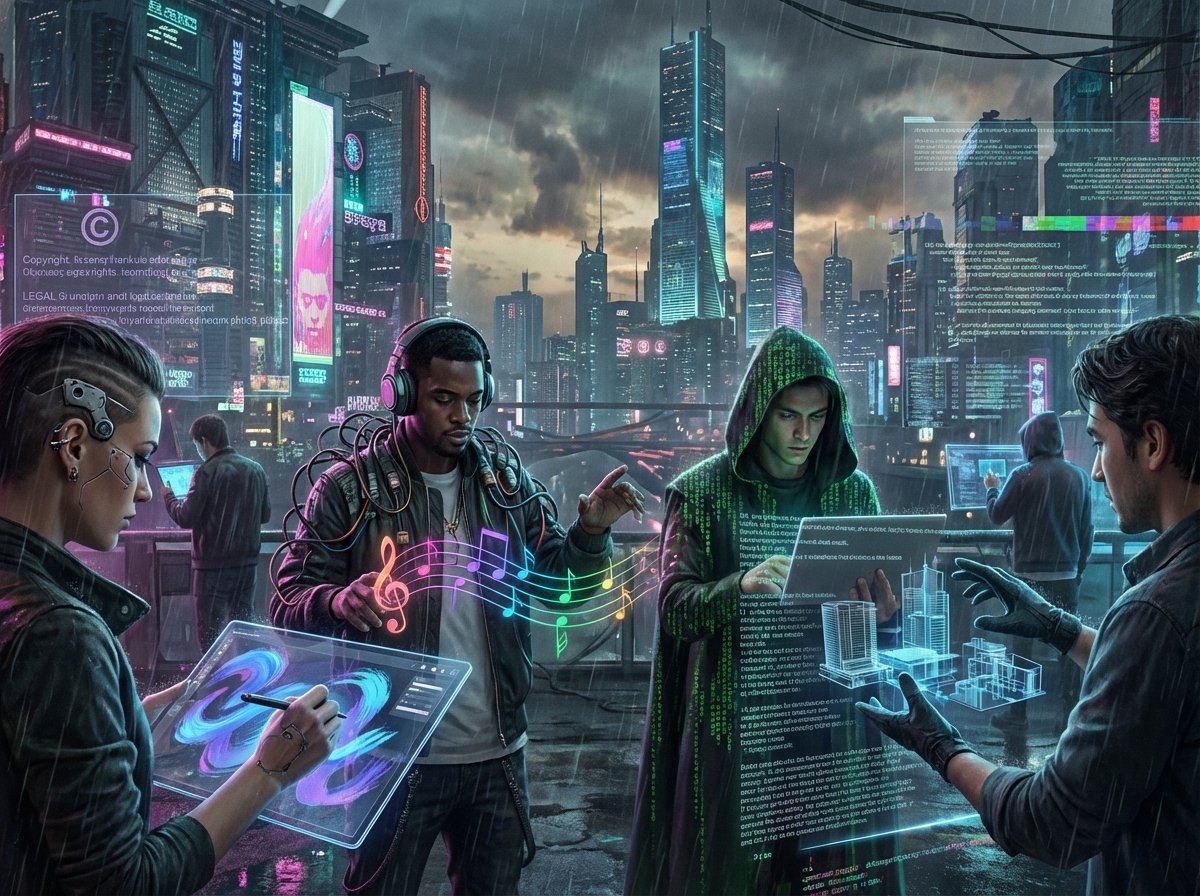
The Transformative Impact of AI Across Creative Domains
AI's influence is not uniform but is tailored to the specific needs and processes of different creative fields, where it is being integrated as a tool for ideation, production, and enhancement.
Art and Design
In visual arts, AI tools like Midjourney, DALL·E, and Stable Diffusion are revolutionizing the creative process. Artists are using text prompts to generate initial sketches, complex digital works, and surreal imagery, accelerating ideation and experimentation. For instance, a designer can use NVIDIA Canvas to transform simple digital brushstrokes into photorealistic landscapes in real time, iterating on visual concepts with remarkable speed.
Music and Audio
The music industry has seen AI adopted for everything from composition to performance. Platforms like AIVA and Soundful allow users to generate royalty-free tracks by selecting moods and genres, serving the needs of filmmakers, game developers, and advertisers. Beyond simple generation, AI is also being used as a live performance partner. Researchers and musicians have developed live-coding agents that improvise alongside human performers, introducing unexpected elements that can push creativity in new directions.
Writing and Content Creation
AI has become an invaluable assistant for writers and marketers. Tools like Jasper and Writesonic can generate first drafts, headlines, and ad copy, while platforms like Frase specialize in SEO-focused content, suggesting keywords and structures to optimize for search intent. For creative writers, tools such as Sudowrite act as brainstorming partners, helping to develop plot structures and overcome writer’s block.
Video, 3D, and Immersive Media
The complex fields of video and 3D design are also being streamlined by AI. Platforms like Runway and Kaiber can generate video clips and motion graphics from text prompts, while tools like Lumen5 can convert entire blog posts into social-media-ready videos. In the realm of augmented and virtual reality (AR/VR), AI is used to generate 3D models and environments, lowering the historically steep technical barrier for creating immersive experiences.
The Democratization of Creative Tools
Perhaps one of AI's most celebrated impacts is its role in democratizing creativity. By embedding complex processes within user-friendly interfaces, AI-powered platforms are breaking down barriers that once limited creative pursuits to those with formal training or expensive resources. An aspiring musician no longer needs a studio to compose a full track, and a small business owner can design a professional-looking flyer without hiring a graphic designer.
This accessibility empowers a more diverse range of voices. Artists in regions historically sidelined by the global art market are using open-source AI tools to create and distribute their work, enriching the cultural landscape with new perspectives. For example, creators in Iran use AI to encode subversive narratives in abstract visuals, while Nigerian artists blend AI with traditional motifs to explore themes of diaspora and identity.
New Models of Human-AI Collaboration
Far from a simple replacement for human artists, AI is fostering new, hybrid models of creativity where human intuition and machine computation work in concert. These partnerships can be categorized into several distinct roles.
AI as Assistant
In its most straightforward role, AI functions as an assistant that automates routine and time-consuming tasks. Research shows that 79% of marketing professionals view AI's primary benefit as empowering human creativity by freeing them from mundane work. This allows designers, writers, and musicians to focus their energy on strategic decisions, ideation, and refinement.
AI as Muse
More profound collaborations occur when AI is used as a source of inspiration. Because AI models can generate unexpected combinations and ideas, they can help creators break through creative blocks and discover novel directions. Computational creativity researcher Mike Cook developed an AI called Pixie to suggest alternative designs for a video game. Asked to create a difficult level, the AI designed a room where the obstacles didn't move, turning the level into a "minefield"—an approach Cook hadn't considered. This element of surprise is a key benefit, pushing creators beyond their habitual patterns.
AI as Collaborator
The most integrated model positions the human as a creative director and the AI as a collaborator. In this dynamic, the creator guides the AI, curates its output, and layers it with human nuance. One Berlin-based artist described this process: “I use AI to generate the starting point, and then my job is to destroy it, rework it, humanize it”. This approach is often described using the metaphor of AI as "scaffolding"—it provides the initial structure, but the human still builds the house, ensuring the final work retains an authentic voice and emotional depth.
Ethical Considerations and Systemic Challenges
Alongside its creative potential, AI presents a host of urgent ethical and economic challenges that threaten the very foundations of the creative industries.
Authorship and Copyright
The most contentious issue is the training of generative AI models. Many of these systems have been built by scraping vast, unlicensed datasets of creative works from across the internet, constituting what many artists and industry bodies call mass copyright infringement. This practice raises complex legal questions about ownership of AI-generated content and has left creators vulnerable, as existing copyright laws are ill-equipped to handle derivative works composed from fragments of thousands of other pieces.
Economic Disruption
The rise of AI-generated content poses a significant threat to the livelihoods of human artists. In the music industry, for example, streaming platforms are increasingly integrating AI-generated music to populate playlists, which could save them billions in licensing fees but drastically shrink royalty streams for human musicians. This devalues human labor and creates a market where independent artists find it nearly impossible to compete. While new AI-specific roles like "prompt engineer" are emerging, there is widespread concern about job displacement across creative fields.
Bias and Homogenization
AI models are not neutral; they reflect the data they are trained on. When datasets lack diversity or contain historical prejudices, AI can perpetuate and amplify these biases in its output. Furthermore, as millions of users rely on the same handful of generative models, there is a growing risk of aesthetic conformity, where outputs begin to look and sound alike, leading to creative homogenization.
Future Implications and the Path Forward
Looking ahead, AI is poised to become not just a tool, but a medium in its own right, much like photography or video in past decades. However, navigating this future requires immediate and decisive action. There is an urgent need for global copyright reform, the establishment of industry-wide ethical guidelines, and legal frameworks that mandate transparency from technology platforms regarding AI-generated content and training data.
For creators, the path forward involves adapting their roles and focusing on the uniquely human strengths that AI cannot easily replicate: emotional nuance, cultural insight, humor, critical thinking, and resonant storytelling. The role of the artist may increasingly shift from pure creator to that of a creative director, editor, and storyteller who wields AI with purpose and vision.
Conclusion
AI is undeniably a paradigm-shifting force in the creative world. It is a powerful engine for democratization, providing sophisticated tools to the masses and enabling novel forms of human-machine collaboration that can augment and inspire human ingenuity. At the same time, it presents a systemic threat to the economic and ethical structures that have long supported creative work. The future of the creative industries depends not on choosing between human and machine, but on mastering their collaboration. By championing ethical practices, demanding fair regulation, and focusing on our irreplaceable human qualities, we can guide this transformation to ensure that technology amplifies creativity rather than erasing it.