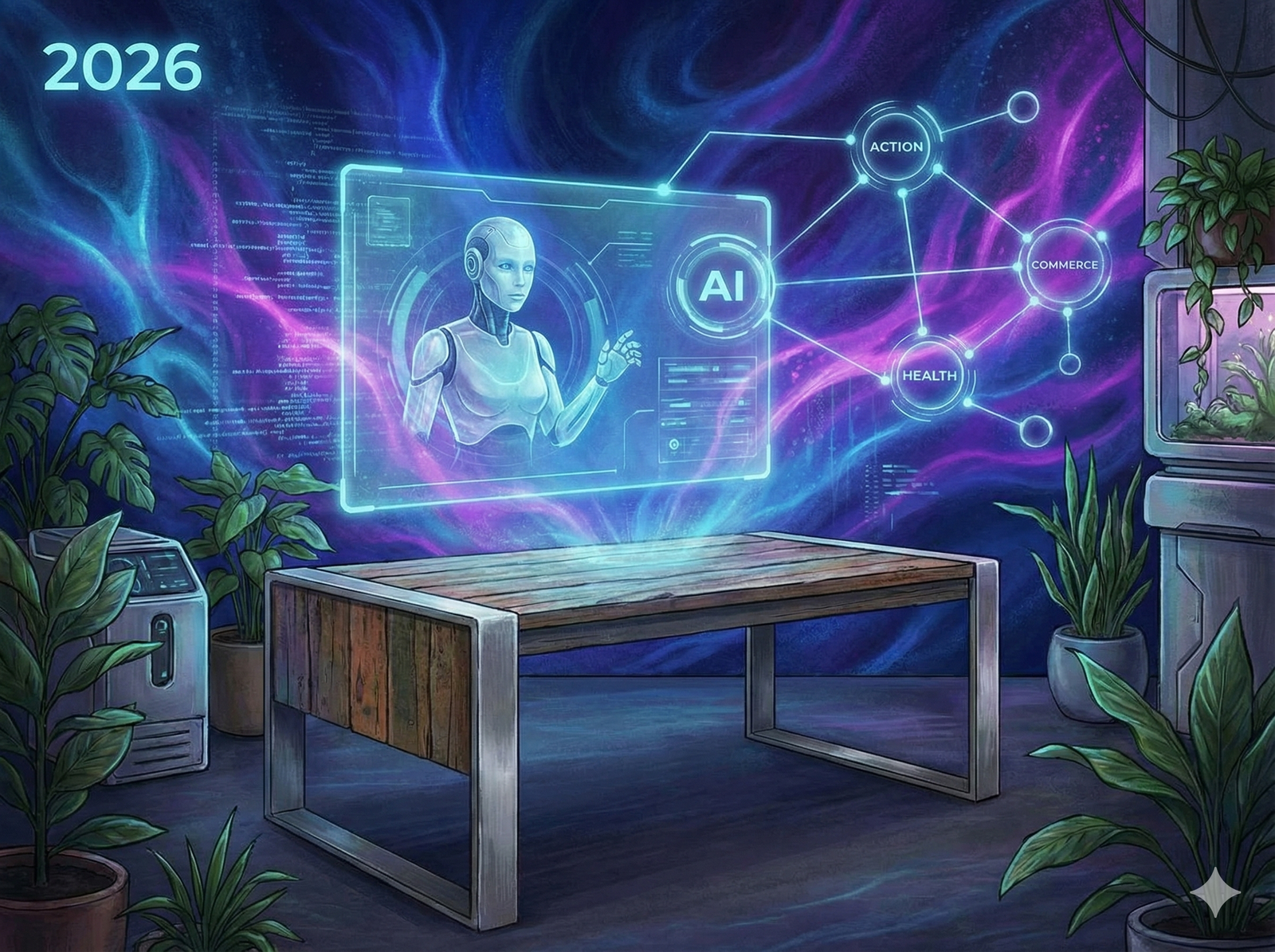
If the first week of January is any indicator, 2026 will be defined not by what AI can say, but by what it can do. As CES 2026 unfolds in Las Vegas, the industry is shifting focus from generative chatbots to "ambient" and "agentic" systems—AI that lives in the background, orchestrating tasks across devices without constant user prompting.
CES 2026: The Hardware of Tomorrow
The Consumer Electronics Show has set a blistering pace this week. NVIDIA officially unveiled the Rubin platform, the successor to the Blackwell architecture. Featuring the new Vera CPU and Rubin GPU, this six-chip platform is designed to handle the immense data loads of next-generation agentic workflows, with CEO Jensen Huang confirming a "codesign" approach to eliminate bottlenecks.
Meanwhile, Intel launched the Core Ultra Series 3 (Panther Lake) processors. These are arguably their most significant push into the "AI PC" market yet, built entirely on the Intel 18A process node to support local, low-latency AI processing.
On the consumer front, Lenovo and Motorola introduced Qira, a personal "ambient" AI. Unlike traditional assistants that wait for a wake word, Qira is designed to build a fused knowledge base (with permission), handling file transfers, trip planning, and context-aware reminders seamlessly across devices.
DeepSeek Challenges the Compute Paradigm
Away from the glitz of Las Vegas, the research community started the year with a significant technical milestone. On 1 January, Chinese startup DeepSeek published research on "Manifold-Constrained Hyper-Connections" (mHC). This training method reportedly allows models to scale significantly without the traditional ballooning of computational costs, challenging the industry consensus that "smarter" always equals "more expensive."
The Dawn of Agentic Commerce
The UK’s Information Commissioner's Office (ICO) released a forward-looking report on 8 January regarding "Agentic Commerce." The report predicts that within five years, personal AI agents will autonomously negotiate prices, track sales, and manage household budgets. While promising, the ICO issued a clear reminder: this level of autonomy requires robust data protection and strictly verified "digital chains of custody."
Health Tech: SleepFM
Finally, researchers at Stanford University unveiled SleepFM, a multimodal AI trained on over 585,000 hours of sleep data. By analysing brain waves, heart rates, and breathing patterns from a single night, the model can reportedly predict risks for over 130 conditions, including heart disease and dementia, marking a massive leap for preventative health technology.