The AI Landscape: A Whirlwind of Innovation and Regulation in Late 2025
As of December 2025, the artificial intelligence sector is experiencing an unprecedented surge of activity, marked by a rapid succession of groundbreaking model releases from industry leaders OpenAI, Google, and Anthropic. Simultaneously, significant new regulations are emerging from the US government, shaping the future operating environment for AI development and deployment. This period signifies a pivotal moment, showcasing both the incredible pace of technological advancement and the growing imperative for responsible governance.
Major AI Model Releases Intensify the "AI Race"
The competitive "AI Race" has reached new heights, with three major frontier model updates deployed within weeks of each other, pushing the boundaries of what AI can achieve.
OpenAI Launches GPT-5.2 and "Atlas" Browser
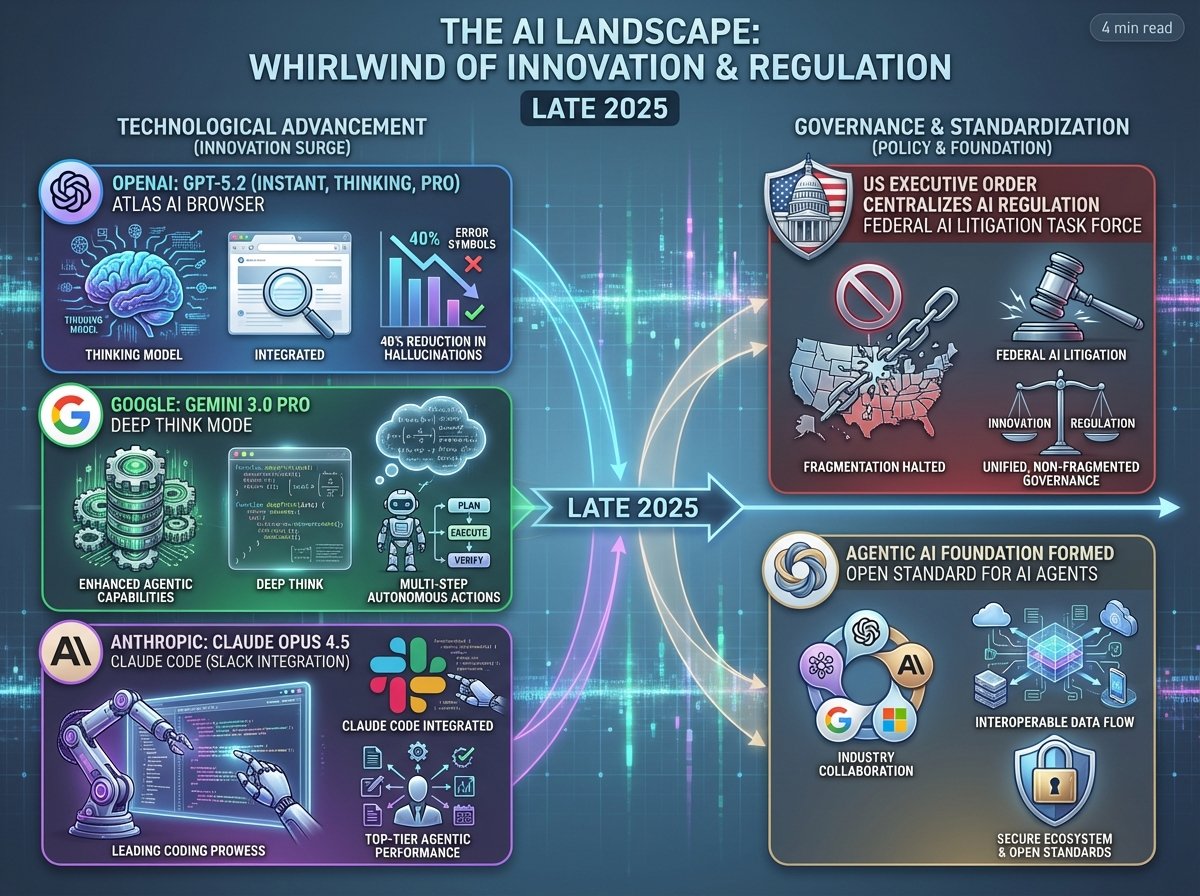
- On December 11, 2025, OpenAI introduced the highly anticipated GPT-5.2 across three distinct versions: GPT-5.2 Instant, GPT-5.2 Thinking, and GPT-5.2 Pro.
- The "Thinking" model is specifically engineered for complex reasoning tasks and professional applications. OpenAI reports a significant reduction in "hallucinations" (model errors) by approximately 40% compared to its predecessors, positioning it as a direct challenger to Google's Gemini 3 and Anthropic's Opus 4.5.
- Further innovating, OpenAI also unveiled "Atlas," a dedicated AI-powered web browser. Atlas is designed to autonomously perform multi-step research and execute complex tasks directly on the web, streamlining workflow for users.
Google Rolls Out Gemini 3.0 with "Deep Think" Mode
- Google's Gemini 3.0 Pro, released in mid-November, significantly enhances "agentic" capabilities, allowing the model to take direct actions rather than merely conversing.
- As of December 4, Google began the rollout of Gemini 3.0 Deep Think to its advanced subscribers. This innovative feature empowers the model to engage in a detailed "thought process" for intricate challenges in mathematics, coding, and logic, ensuring more accurate and robust solutions before providing an answer.
Anthropic Updates with Claude Code and Opus 4.5
- On December 8, Anthropic introduced "Claude Code," a specialized tool designed for direct integration into Slack. This autonomous coding agent can identify and fix bugs, refactor code, and execute tests within a developer's existing chat environment, significantly boosting productivity.
- Preceding this, on November 24, Anthropic released Claude Opus 4.5, their most powerful model to date. It boasts leading performance metrics in both coding and general agentic tasks, solidifying Anthropic's position at the forefront of AI development.
Significant Policy & Regulatory Developments
Alongside the technological breakthroughs, the regulatory landscape for AI is also undergoing rapid transformation, with critical new policies emerging from the US government and unprecedented industry collaboration.
Executive Order Aims to Centralize US AI Regulation
- On December 11, 2025, President Trump signed a new Executive Order intended to prevent individual states, such as California and Colorado, from enacting their own separate AI safety regulations.
- The order establishes a federal "AI Litigation Task Force" specifically designed to challenge state-level AI legislation. The administration's rationale is that a fragmented approach with diverse state regulations could impede American innovation and competitiveness in the global AI arena.
Formation of the "Agentic AI Foundation"
- In a rare display of industry cooperation, OpenAI, Anthropic, and Block, with support from Google and Microsoft, jointly founded the Agentic AI Foundation under the umbrella of the Linux Foundation on December 9, 2025.
- The primary objective of this foundation is to establish a shared, open standard for "AI Agents." These agents are software entities capable of independently performing multi-step tasks like booking travel, drafting code, or managing complex data. The initiative aims to ensure secure interoperability among different AI agents across various platforms, fostering a cohesive and safe ecosystem.
The "Big Three": A Snapshot of AI Leadership (Mid-December 2025)
Here’s a concise overview of the latest flagship models and key advancements from the leading AI developers:
- OpenAI: Their latest flagship, GPT-5.2 (Thinking/Pro), debuted with advanced reasoning and the innovative "Atlas" AI Browser.
- Google: With Gemini 3.0 Pro, Google enhanced agentic capabilities and rolled out the powerful "Deep Think" reasoning feature.
- Anthropic: Their top model, Claude Opus 4.5, leads in coding and agentic tasks, complemented by the new "Claude Code" agent for Slack integration.