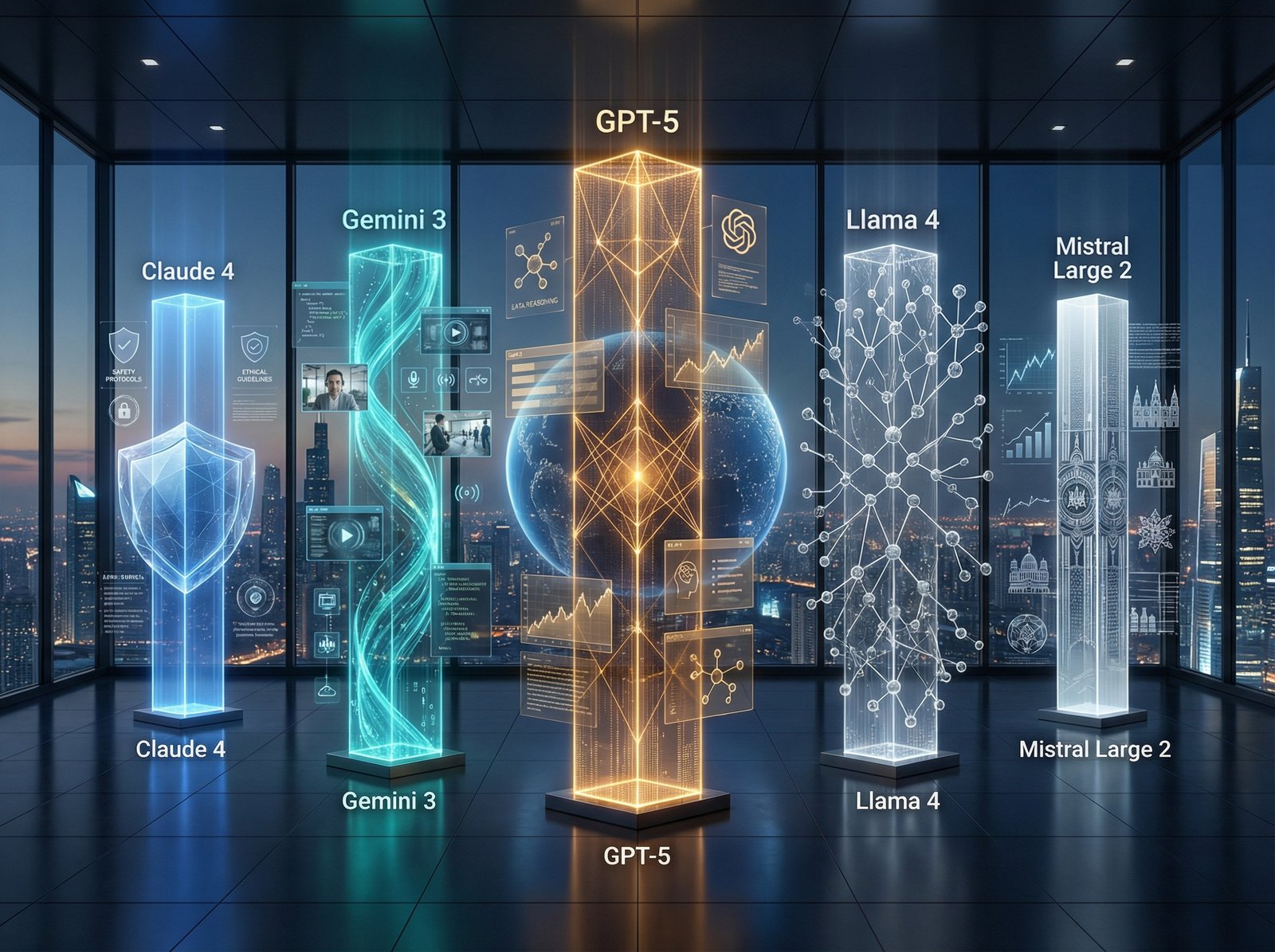
This article focuses on publicly announced capabilities of major AI models and avoids speculative parameter counts or unverified case studies.
The Vanguard of Intelligence: A Fact‑Based Look at GPT‑5, Claude 4, Gemini 3 and the Leading AI Models of 2025/26
The 2025/26 Frontier Model Landscape
By late 2025 and into early 2026, a small number of "frontier" model families dominate the public AI conversation: OpenAI's GPT‑5, Anthropic's Claude 4, and Google DeepMind's Gemini 3. These systems are multimodal, agent‑oriented, and are increasingly being embedded into productivity suites, developer tools, and consumer products.
Alongside them, open‑weight and regional models such as Meta's Llama series and European efforts like Mistral provide important counterbalance, especially for custom deployments and sovereignty‑minded organisations.
GPT‑5: OpenAI's Latest Flagship
OpenAI launched GPT‑5 in early August 2025 as the successor to GPT‑4, positioning it as a major step forward in reasoning, coding, and multimodal understanding. GPT‑5 is accessible via ChatGPT for both free and paid users and is also exposed through the OpenAI API and Microsoft Copilot integrations.
OpenAI describes GPT‑5 as combining the strengths of earlier GPT‑4‑class models with advances from its reasoning‑first "o‑series" models, enabling more reliable multi‑step problem‑solving and tool use. Public coverage from outlets like the BBC and Wired has highlighted improved performance in complex tasks, reduced hallucinations compared to GPT‑4, and a push towards what OpenAI leadership calls "PhD‑level" capability, while still explicitly avoiding a formal claim of AGI.
How GPT‑5 Shows Up in Practice
Rather than being a standalone curiosity, GPT‑5 is increasingly embedded into products that many users touch daily. Microsoft's Copilot experiences in Office and Windows, GitHub integrations, and third‑party SaaS tools built on the OpenAI API use GPT‑5 as a default or premium option for tasks like code generation, document summarisation, and data‑aware assistants.
OpenAI has also positioned GPT‑5 as a platform for building "agents": workflows where the model can reason across longer contexts, call tools or APIs, and orchestrate steps towards a goal under user supervision.
Claude 4: Anthropic's Safety‑Focused Collaborator
Anthropic released Claude 4 (including variants such as Claude Opus 4 and Claude Sonnet 4) in May 2025 as the next generation of its Claude assistant family. The company presents Claude 4 as a model designed for sustained collaboration on complex tasks, with strong performance in coding, analysis, and long‑form reasoning.
Anthropic emphasises safety and "Constitutional AI" as key elements of Claude's design, aiming to make the system helpful while reducing harmful or untrustworthy outputs. Reporting has also noted Anthropic's focus on agent‑like behaviour, where Claude can work over extended periods on tasks such as reviewing long documents or iterating on technical work.
Claude 4 in the Real World
Claude 4 is available through Anthropic's own interface, through partner platforms, and via APIs, and it competes directly with GPT‑5 in areas like software development assistance, research support, and enterprise knowledge work. Public benchmarks shared by Anthropic suggest strong results on coding and reasoning tasks compared with earlier Claude versions, though the company itself notes that many of these are internal evaluations and encourages independent testing.
Anthropic has also partnered with major cloud providers, including Amazon, to make Claude 4 available as part of managed AI services for organisations that want a safety‑focused alternative to other frontier models.
Gemini 3: Google's New Intelligence Standard
In November 2025, Google DeepMind released Gemini 3, marking what the company describes as "a new era of intelligence". Gemini 3 Pro launched first on November 18, 2025, followed by Gemini 3 Flash in December 2025. The model emphasises deeper reasoning capabilities, stronger multimodal understanding, and a 1 million token context window.
Google positions Gemini 3 as its most intelligent model to date, with state‑of‑the‑art performance in multimodal understanding and what it calls "vibe coding"—the ability to create rich, interactive applications from natural language descriptions. The model tops several benchmarks and introduces Deep Think mode, an enhanced reasoning capability that pushes performance even further on complex problems.
Gemini 3 Across Google's Ecosystem
Gemini 3 Flash is now the default model in the Gemini app, replacing Gemini 2.5 Flash. It's described as delivering "frontier intelligence built for speed" with PhD‑level reasoning at a fraction of the cost of larger models. The model is integrated across Google's products, including a new AI Mode in Search that launched alongside Gemini 3—the first time Google has shipped a new Gemini model in Search on day one.
Developers can access Gemini 3 models via Google AI Studio and Vertex AI. Google has also introduced Antigravity, a new agentic development platform designed to work with Gemini 3's capabilities. The combination of long context windows, multimodal understanding, and tool use makes Gemini 3 particularly suited for complex workflows involving entire codebases, long documents, and multi‑step reasoning tasks.
Open‑Weight and Regional Models: Llama and Mistral
While GPT‑5, Claude 4, and Gemini 3 dominate many headlines, open‑weight models such as Meta's Llama family and European efforts like those from Mistral play a crucial role in giving organisations more control over deployment, data, and cost structures. These models are often chosen when teams want to run AI on their own infrastructure or customise systems heavily for domain‑specific use.
Meta continues to iterate on Llama as a widely used open‑weight model line, and Mistral's models have gained attention in Europe for competitive performance and a focus on efficient deployment. Exact version names and parameter counts vary over time, but the general trend is clear: high‑performing open‑weight models are now a serious alternative or complement to closed frontier systems in many workflows.

Where Things Stand in Early 2026
As we survey the landscape of 2026, it is clear that the "one model to rule them all" mentality is obsolete. No major AI lab has formally declared AGI, and the industry has settled into a rhythm of competitive co-existence. For practitioners, the practical reality is a multi-model future.
The strategic decision for organizations is not choosing a winner, but rather orchestrating a portfolio of models:
- Use GPT-5 for complex, reasoning-heavy tasks and workflows integrated into the Microsoft stack.
- Use Claude 4 for highly sensitive, long-form collaboration where safety and nuance are non-negotiable.
- Use Gemini 3 for multimodal analysis, massive context processing, and workflows within the Google Workspace.
- Use Llama/Mistral for high-volume, low-latency tasks, or applications requiring strict data sovereignty and custom fine-tuning.
The vanguard of intelligence in 2026 is defined not just by the capability of the models, but by the sophistication of the humans and agents employing them. As these tools become deeply embedded in our daily lives, the focus shifts from the novelty of generation to the reliability of results.